 Donate
Copied
Practical Application of Evidence-Based Dietary Therapy in Inflammatory Bowel Disease: The DELECTABLE Program
Abstract
Background/objectives: Exclusive Enteral Nutrition (EEN) and the Crohn's Disease Exclusion Diet (CDED) have been shown to induce remission in Crohn's disease. Low-sulphur, plant-based diets are being explored for ulcerative colitis, and wholefood, low-additive approaches are emerging as significant. Although Inflammatory Bowel Disease (IBD) patients modify their diet, evidence for tolerability and benefit outside clinical trials is limited. The DELECTABLE program aimed to assess satisfaction, adherence, and efficacy of dietary therapies as part of IBD care.
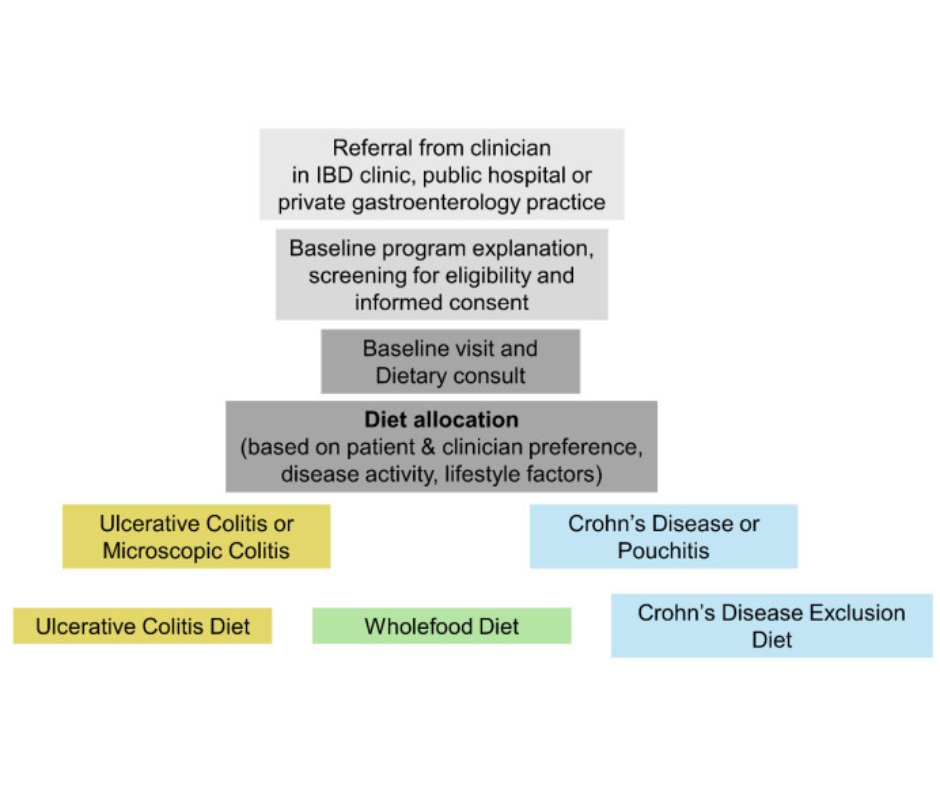
Methods: In this dietitian-led, open-label, prospective study, patients with Crohn's disease were offered the CDED or a whole-food, additive-free diet (WFD), and patients with ulcerative colitis were offered a low-sulphur, plant-based diet (UCD) or WFD. Primary outcomes were 12-week diet satisfaction (modified DSAT-28) and diet adherence, including food additive intake. Secondary outcomes were quality of life (QoL) (IBDQ-9), disease activity (CDAI for Crohn's disease, partial Mayo score for ulcerative colitis), and biochemical markers (CRP, faecal calprotectin). Analyses were conducted within, rather than between, diet arms due to the non-random nature of the study. Diet adherence and disease activity change across time points (baseline, week 6, week 12) were assessed using repeated measures ANOVA or Friedman's test, with pairwise paired t-test or Wilcoxon Signed-Rank test. Diet satisfaction and quality of life changes across time (baseline/week 1, week 12) were assessed using a paired t-test or Wilcoxon Signed-Rank test.
Results: Of 165 referrals, 76 patients enrolled, with 64 completing the 12-week program (CDED: n = 15, WFD: n = 42, UCD: n = 7). Diet satisfaction was initially high and remained stable over time on CDED (p = 0.212) and improved on WFD (p = 0.03). Patient- and dietitian-rated adherence was high at baseline and did not significantly decrease on any diet arm (p > 0.349). Food additive intake decreased on WFD (p = 0.009). QoL improved on CDED and WFD (p < 0.001). CRP, calprotectin, and CDAI were reduced on CDED (p < 0.045), and CDAI and partial Mayo were reduced on WFD (p < 0.027).
Conclusions: Well-balanced therapeutic diets are feasible and well-accepted by patients with IBD, with a promising impact on disease activity.
Details
Title
Practical Application of Evidence-Based Dietary Therapy in Inflammatory Bowel Disease: The DELECTABLE Program
Type of Article
Primary Research
Diets studied
CDED
EEN
Date
May 6, 2025
Author(s)
Trakman GL, Russell EE
Publication
Nutrients
Citation
Trakman GL, Russell EE, Hamilton AL, Wilson-O'Brien A, Thompson E, Simmance N, Niewiadomski O, Kamm MA. Practical Application of Evidence-Based Dietary Therapy in Inflammatory Bowel Disease: The DELECTABLE Program. Nutrients. 2025 May 6;17(9):1592. doi: 10.3390/nu17091592. PMID: 40362901; PMCID: PMC12073524.
ISSN Number
Volume
Pages


Support our Mission
Your donation will help us to enhance the well-being and health outcomes of patients with GI conditions.
Donate